
SitRep - 2024/09/07
The recent reinforcements to the Pokrovsk sector are making a difference.

In my last SitRep, I used the comparison of “hide-and-seek” to the modern life Squid Game that is the characterizes the tactics of Russian assault infantry. The term more commonly used is “accumulation” tactics.
Remember that the today’s frontlines are not linear. Trench lines typically stretch for less than a hundred meters, and most forward defensive positions are held by only a handful of soldiers. If the soldiers at a position are attacked, they can request fire support (like artillery and air strikes) to help them hold out until reinforcements arrive.
Accumulation tactics take advantage of the wide open spaces between defensive nodes. Here is a recent example from near Pokrovsk:
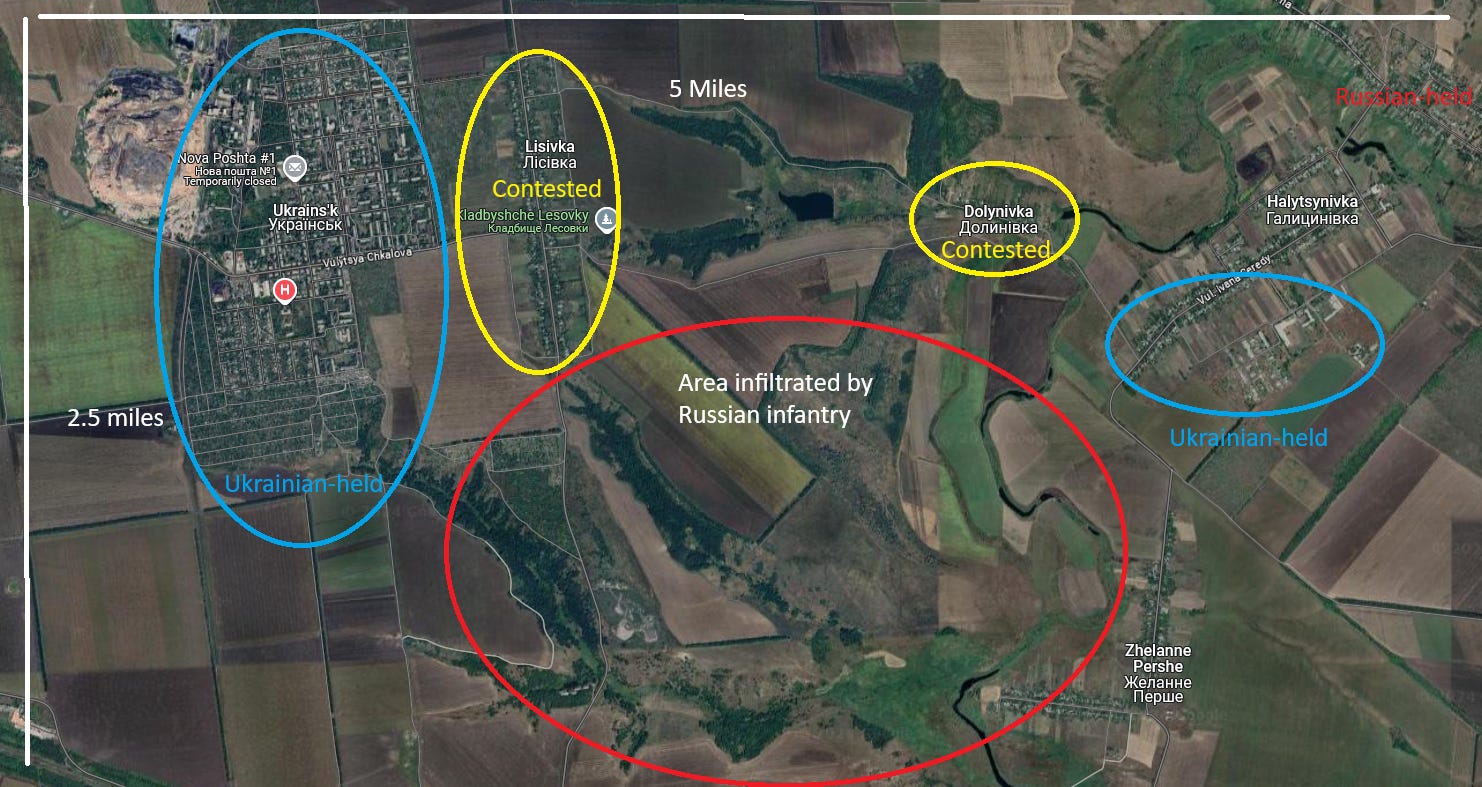
Around 9/4, Lisivka and Dolynivka were grey zone and contested by both sides. Ukrainsk and Halytsynivka were (and still are) mostly held by Ukrainian forces. To best utilize mechanized forces, Ukraine has focused on holding the urban centers, so on 9/4 and 9/5, small teams of Russian infantry infiltrated the woods, fields and treelines between the settlements, often employing a Russian drone overhead to provide reconnaissance. Many of these groups were spotted and destroyed, but some survivors slipped through to entrench themselves.
Once firmly inside their newly-made defensive positions, Russian soldiers could call in artillery and air strikes, while organizing assaults on the now exposed flanks of forward Ukrainian positions. If Ukrainian drone operators do not spot every Russian, solid defensive positions may find themselves outflanked by the next morning.
By 9/6 Ukrainian positions near Lisivka and Dolynivka had become untenable by the threat to their rear. The Ukrainians withdrew, and the Russians gained footholds in both settlements.
Accumulation tactics and the non-stop game of hide-and-seek played between Ukrainian drones and Russian infantry has allowed Russia to make gradual advances at an exorbitant cost.
Importantly, these tactics are most effective before the leaves fall in autumn. By November this extra concealment will be gone, and dry ground will give way to mud. It is unlikely that the changing seasons will stop the Russians from attacking, but it will make hiding and advancing much more difficult.
To the fronts:
Kursk:
Russia is relying on battered veteran units heavily supplemented with teenage conscripts to address the Ukrainian incursion. Ukrainian air and missile strikes on Russian pontoon bridges across the Seym are choking off supplies to the Russian units operating south of the river.
Kupyansk:
The Russians continue assaults near Synkivka and Pishchane. The Russian salient near the latter is colorfully described as the “Pishchane tongue,” by some Ukrainian observers. Russian forces have not made significant progress in the past few days.
Pokrovsk:
An interesting drama has been playing out beneath a rail bridge between Selydove and Mykhailivka.
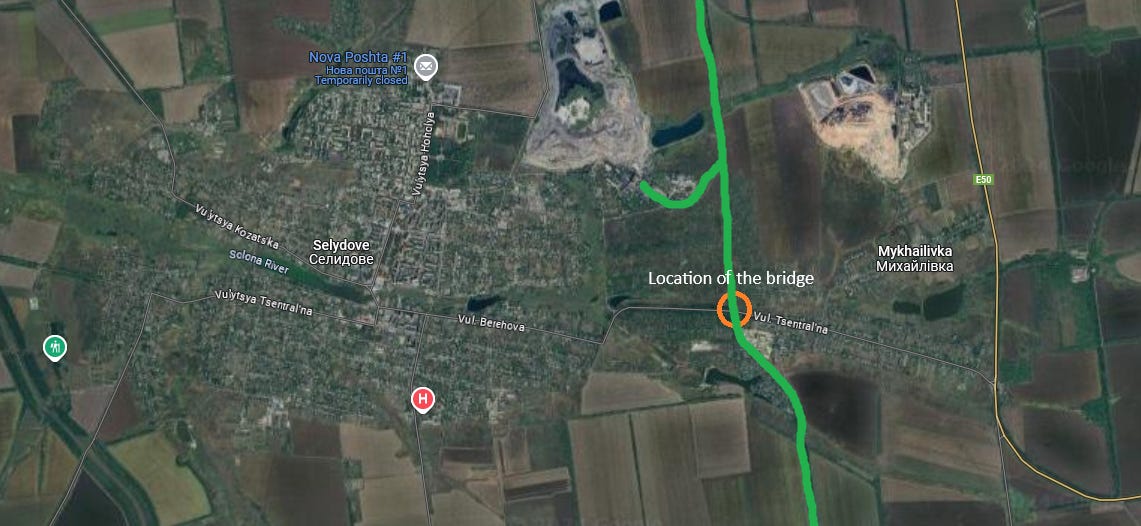
Selydove, a city with a pre-war population of ~21,000, is separated from Mykhailivka by a stretch overgrown ruins and a railway line. After an hour of searching, I do not have a definite answer for what exactly are these ruins. They are not included in the official boundaries of Selydove or Mykhailivka. My best guess is that these dwellings are relics from collectivization — housing serving the miners of the nearby coal mines. The combination of the woody growth, ruins, and rail line has been to limit traffic of armored vehicles and tanks to the Vulytsya Tsentralna — Central Street.
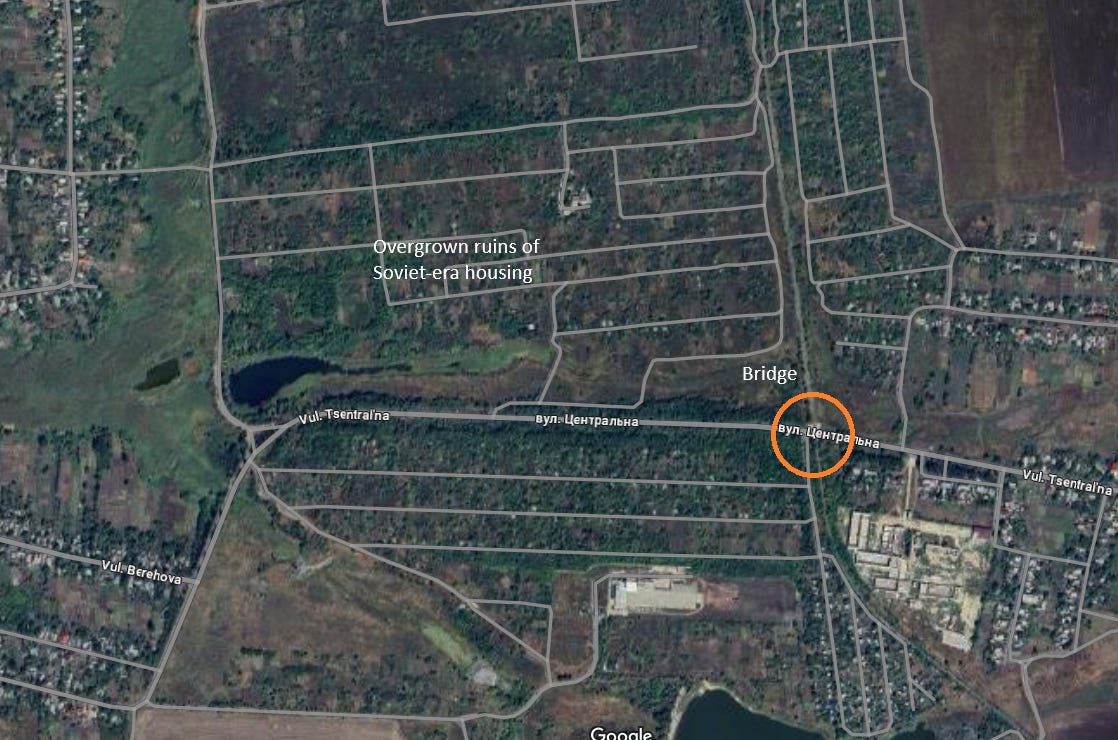
If Russian forces were able to conduct effective mechanized maneuvers, limiting armored vehicle traffic to a single road might have been important to Ukrainian defenders. But ironically, it is only the Ukrainian defenders — the 15th “Kara-Dag” Brigade of the National Guard — who can competently conduct mechanized warfare.
Here’s a close-up of the bridge itself:
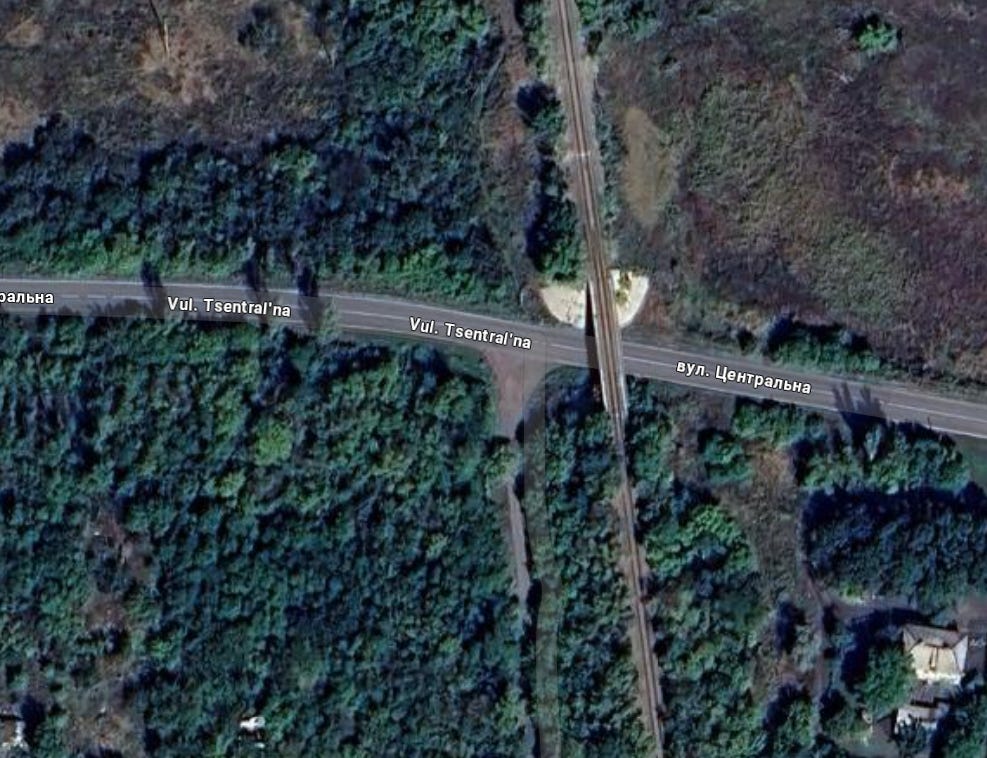
Since Monday, Russian forces have attempted to block Central Street at the rail bridge using their own armored vehicles — even usable ones. In fact, after a Russian crew intentionally abandoned a T-72 main battle tank there, Ukrainian tankers promptly stole it.
By blocking the pass, Russian forces hope to prevent Ukrainian tanks and fighting vehicles from lighting up Russian infantry each time they try to initiate an assault on Ukrainian positions in western Mykhailivka. By unblocking this path using tanks and engineering equipment to bulldoze a path through wrecked Russian vehicles, the Kara-Dag brigade is able to continue supporting its infantry with mechanized forces when need. The Russians have attempted to block the pass almost every day this past week (since Monday).
Finally, after wasting one tank, two infantry fighting vehicles, and an armored transport, the Russians used a high-precision missile to destroy the bridge on 9/7.
The loss of the underpass will make holding Mykhailivka more difficult. But more broadly, the entire drama has highlighted the efficacy of Ukraine’s reinforcements to the Pokrovsk sector.
In addition to the Kara-Dag brigade, the 93rd Mechanized and 59th Motorized brigades have reinforced some of the exhausted defenders of Pokrovsk. The 47th Mechanized, who rotated to Avdiivka in October 2023, and have held the Avdiivka-Pokrovsk front together for 10-11 straight months, are finally enjoying some R&R.
The 93rd — dubbed “cyborgs” for their stalwart defense of Donetsk airport in 2014-2015 — fought in the 2022 Kharkiv offensive and in the Battle of Bakhmut. They are one of the Ukrainian brigades that are actually closer to the size of a division. The 59th include two famous units: “Da Vinci’s Wolves” and “Chosen Company”. The former earned international recognition as a top-notch assault unit while fighting as part of the 67th during the 2022 Kharkiv Offensive and the Battle of Bakhmut — particularly for its actions defending the “Road of Life” at a critical moment during the battle.
The Chosen Company is an assault unit mainly staffed by Americans and a few other foreign volunteers. It is led by Ryan O’Leary, a National Guardsman from Iowa. It is known as a hard-fighting unit, but earlier this year the New York Times published evidence and eyewitness testimony that Americans within the unit had routinely executed surrendering and captured unarmed Russians, while Chosen commanders were complicit in covering up the killings.
Broadly speaking, the 93rd, 59th, and 15th are solid Ukrainian units with a well-known reputation combat savvy. So far, Kara-Dag has been singled out by General Syrskyi (the top Ukrainian commander) for its excellent defense of Selydove in the last few days. The 59th has earned the praise from military observers for its tenacious defense near Ukrainsk and Halytsynivka.
Vuhledar:
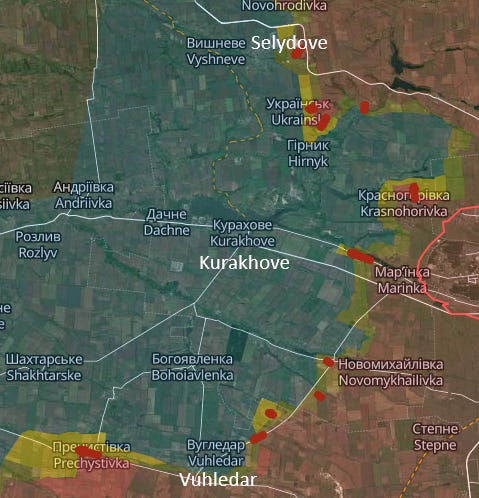
Vuhledar anchors the southern flank of the Ukrainian salient centered at Kurakhove, an important logistics node. By attacking the salient from the north, south, and east, Russian forces are stretching Ukrainian forces to defend mutually supporting avenues of attack.
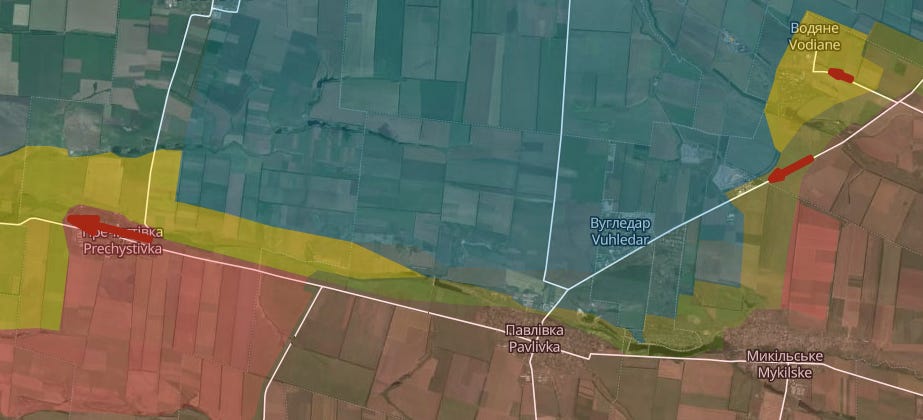
Beginning early last week, Russian forces began assaulting Vodiane and Prechystivka. The goal appeared to be to bypass and outflank the garrison at Vuhledar by attacking the towns surrounding the city. Prechystivka fell quickly, and much of Vodiane is now contested. Building on these successes, Russian forces promptly began conducting frontal assaults on Vuhledar itself.
Unsurprisingly, these direct attacks failed with heavy losses. Increasingly, Ukrainian military observers are referring to the Vuhledar front with cautious optimism. Besides the loss of Prechystivka, Russian forces not advanced significantly.
Good sitrep!